What is AT?
AT stands for Ataxia-telangiectasia (also know as Louis-Bar Syndrome), a rare disease that affects the nervous system, immune system and other body systems. The disorder is characterised as a progressive degenerative disease that results in a loss of fine motor skills and often a weakening of the immune system, which results in patients being more susceptible to contracting other illnesses (puts patients at a higher risk). AT is a disease that occurs in one of every 40,000 to 100,000 people worldwide.
Origin of the Word
Ataxia
Ataxia describes a lack of muscle control during voluntary movements, such as walking or picking up objects. A sign of an underlying condition, ataxia can affect movement, speech, eye movement and swallowing
 Telangiectasia(s)
Telangiectasias, also known as spider veins or angioectasias, are small dilated blood vessels near the surface of the skin or mucous membranes, measuring between 0.5 and 1 millimeter in diameter
Causes
 |
| ATM gene loci |
 |
| AT patient karyotype |
Inheritance
 |
| Figure 2-Punnett Square |
| Figure 1-Visual Representation |
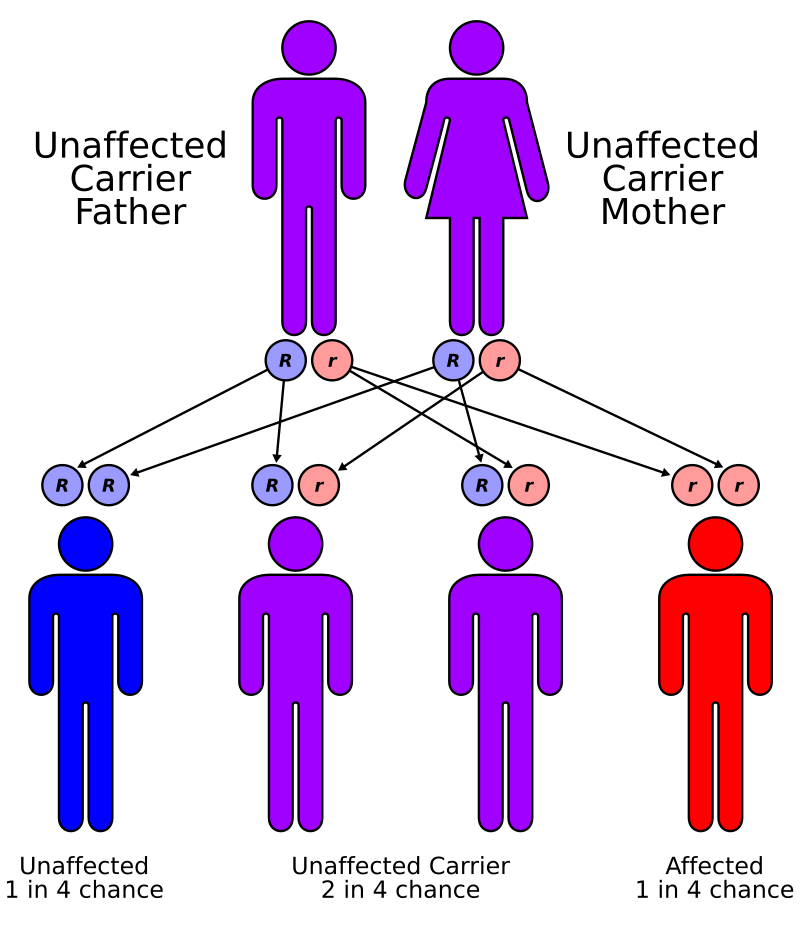
have a child in which the disease is expressed is 25% (RR as illustrated in figure 2) and the likelihood that they receive normal genes from both parents and consequently be unaffected is equivalent (rr as illustrated in figure 2). Conversely, the likelihood in having a child who is also a carrier (heterozygous) is 50% (Rr as illustrated in figure 2). AT is a disease that usually begins during infancy (1-3 years of age) and is a disease that often is not isolated to one child (often affects more than one child in a family). AT affects both sexes equally on average and as previously stated is extremely rare occurring only once every 40,000 to 100,000 births globally (0.001-0.0025%).
As AT is a disease that affects so many different systems within the human body, the symptoms are astronomical, however, the main affects that can be observed include:
- Ataxia (difficulty with control of movement) that is apparent early but worsens in school to pre-teen years
- Oculomotor apraxia (difficulty with coordination of head and eye movement when shifting gaze from one place to the next)
- Involuntary movements
- Telangiectasia (dilated blood vessels) over the white (sclera) of the eyes, making them appear bloodshot. These are not apparent in infancy and may first appear at age 5–8 years. Telangiectasia may also appear on sun-exposed areas of skin.
- Problems with infections, especially of the ears, sinuses and lungs
- Increased incidence of cancer (primarily, but not exclusively, lymphomas and leukemias)
- Delayed onset or incomplete pubertal development, and very early menopause
- Slowed rate of growth (weight and/or height)
- Drooling particularly in young children when they are tired or concentrating on activities
- Dysarthria (slurred, slow, or distorted speech sounds)
- Diabetes in adolescence or later
- Premature changes in hair and skin (graying of hair for instance)
- Hypersensitivity to ionizing radiation with increased susceptibility to cancer (usually leukemia or lymphoma)
- Endocrine abnormalities including insulin-resistant diabetes mellitus and premature ovarian failure (i.e., normal menarche followed by irregular menses and loss of ovarian function before age 40 years)
- Shortened life expectancy (around 25 years)

No comments:
Post a Comment