Gatti, R. (2016, October 27). Ataxia-Telangiectasia. Retrieved February 26, 2017, from https://www.ncbi.nlm.nih.gov/books/NBK26468/
Ataxia-telangiectasia - Genetics Home Reference. (n.d.). Retrieved February 26, 2017, from https://ghr.nlm.nih.gov/condition/ataxia-telangiectasia#genes
(n.d.). Retrieved February 26, 2017, from http://atlasgeneticsoncology.org/Deep/ATMID20006.html
Chromosomal Breakage Syndromes: Background, Pathophysiology, Ataxia Telangiectasia. (2016, September 21). Retrieved February 26, 2017, from http://emedicine.medscape.com/article/951148-overview
Ataxia-telangiectasia. (2017, February 21). Retrieved February 26, 2017, from https://en.wikipedia.org/wiki/Ataxia-telangiectasia#Symptoms
(n.d.). Retrieved February 26, 2017, from http://www.nature.com/nrm/journal/v9/n10/fig_tab/nrm2514_I1.html
Ataxia-Telangiectasia. (n.d.). Retrieved February 26, 2017, from http://primaryimmune.org/about-primary-immunodeficiencies/specific-disease-types/ataxia-telangiectasia/
Timeline- (n.d.). Retrieved February 27, 2017, from http://www.nature.com/nrm/journal/v9/n10/fig_tab/nrm2514_I1.html
Important Dates
1926-Discovery of Disease
1988-AT locus mapped
1995-Cloning and identification of ATM gene
2004-Role of ATM described
2005-ATM gene linked to cancer prevention
2007-ATM activation described
Most Important Contribution (in my opinion)
In my opinion, the most important discovery in the journey to find a cure for AT, is the discovery of the ATM gene. I feel this because without the ATM gene, scientists would be lost. Before the ATM gene was discovered, scientists were looking in a very broad area in regards to figuring out the cause of the disease and consequently were not making much progress. What the discovery of the ATM gene did was help to narrow down the search substantially. This in turn has greatly increased the rate of progress towards finding a cure and consequently, without this discovery we would most likely know a fraction of what we know about the disease today. This could be a discovery that someday perhaps will save lives. On another note, this discovery also holds great importance to the fight against cancer as well. Since the ATM gene is considered a gene that helps protect against cancer (limits rate of cell division and helps repair damage to DNA) finding a solution to reactivating the ATM could prove beneficial to the treatment of both diseases. One solution could be the cure to both diseases (the preverbal killing of two birds with one stone). For these reasons, I strongly believe that the discovery of the ATM gene in 1995 is of the highest importance.
Like all diseases, the first step is the acceptance that something is not right. This relies heavily upon the ability to recognize and interpret the symptoms when they are present. In regards to AT in particular, this can be particularly difficult. Since AT is a disease that affects children from a young age, it is often difficult to recognize these symptoms until the child is older, as slurred talking, drooling and poor motor skills are not uncommon for young children. For this reason, this is often one of the most difficult yet important stages in the diagnosis process.
Methods of Diagnosis
Single-Gene Testing (Limited)
Sequence analysis of ATM is performed first followed by gene deletion and or duplication analysis in chromosomes in body cells
Multi-Gene Testing
Similar to single-gene testing but it also accounts for various genes that are commonly affected by the ATM gene to check for variation due to mutation.
Comparison of Multi and Single Gene Testing
Immunoblotting for ATM
A process by whichantigenscan be separated by electrophoresisandallowed to adhere to nitrocellulosesheetswheretheybindnon-specificallyandthenaresubsequentlyidentified by stainingwithappropriatelylabeledantibodies.
MRI
Used to monitor brain development and to observe whether brain function is diminishing over an extended period of time. This is also important for locating where loss in brain activity is located. For instance AT tends to affect the cerebellum, the center of the brain responsible for motor skills almost exclusively. This can help narrow down the diagnosis but cannot ultimately determine if it is AT (other diseases affect the cerebellum as well).
Alpha-Fetoprotein Levels
For reasons unknown to scientists, AT patients tend to have elevated Alpha-Fetoprotein (AFP) levels above 10ng/mL. In no way does this correlate with neurological defects but it does occur in 95% of AT patients.
Chromosome Analysis
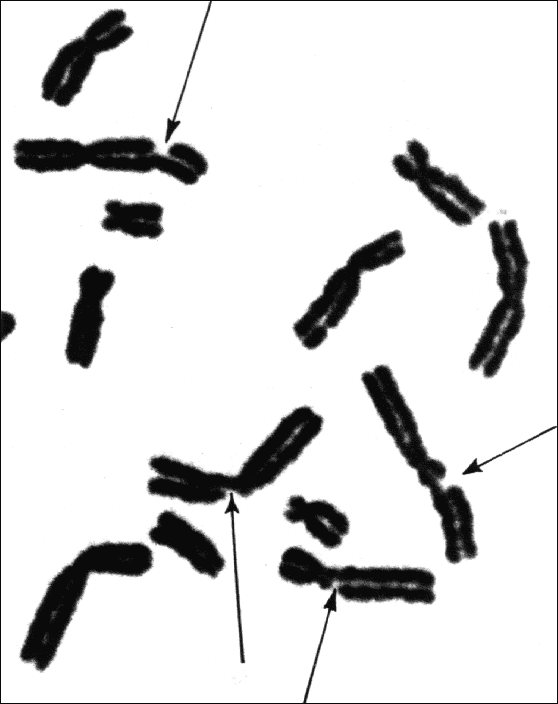
Chromosomal transposition occurs often (10-15% of patients), usually occurring between chromosome 7 and 14. Chromosomal breaks are also quite common, which can occur with any the chromosomes. Breaks are often one of the easiest ways to diagnose AT as it indicates a malfunction with the ATM gene, thus narrowing down the possibilities tremendously.
Treatment
Present
As of today, there stands no treatment or prevention of AT. Much of the health care provided for AT patients is in regards to increasing their life expectancy. As AT is a disease that often targets the immune system causing immunodeficiency in patients, this puts patients at an increased risk of getting infections. In order to ward off these infections, antibiotics are used. Patients are also given immune globulin injections as well as blood transfusions (blood contain white blood cells) in order to boost patients immune system in order to help the body fight off illness.
Future
Similar to how cancer has yet to have a cure, AT does not have one either. This is because they are both accentually trying to solve the same issue. In both cases, they are working to find a cure to restore the natural rate of cell division and the ability for the body the repair DNA strands by reactivating the ATM gene. The distinction is that AT can cause cancer but cancer cannot cause AT. Due to the similarities in the two diseases, consequently the solutions are similar, and today that means stem cell research. Additionally, SMRT compounds are also being researched heavily but more as something that could help extent life expectancy of AT patients.
AT stands for Ataxia-telangiectasia (also know as Louis-Bar Syndrome), a rare disease that affects the nervous system, immune system and other body systems. The disorder is characterised as a progressive degenerative disease that results in a loss of fine motor skills and often a weakening of the immune system, which results in patients being more susceptible to contracting other illnesses (puts patients at a higher risk). AT is a disease that occurs in one of every 40,000 to 100,000 people worldwide.
Origin of the Word
Ataxia
Ataxia describes a lack of muscle control during voluntary movements, such as walking or picking up objects. A sign of an underlying condition, ataxia can affect movement, speech, eye movement and swallowing
Telangiectasia(s)
Telangiectasias, also known as spider veins or angioectasias, are small dilated blood vessels near the surface of the skin or mucous membranes, measuring between 0.5 and 1 millimeter in diameter
Causes
ATM gene loci
AT is caused due to mutation of the ATM (ataxia-telangiectasia mutated) gene which is located on the long arm of chromosome 11 (11q22.3). Even though the genetic differences are unfathomably small, the effects have devastating results due to the crucial functions the ATM gene perform within the human body. The ATM gene is responsible for providing instructions for the making of proteins that help control cell division and is involved in DNA repair. These proteins assist cells in recognizing damaged or broken DNA strands and help facilitate DNA repair by activating certain enzymes that help to fix these strands. This is a crucial function required in order to maintain and protect the cell's genetic information. In AT patients, this gene has undergone mutation during infancy, inhibiting the necessary functions of the ATM gene. Without the caring out of these functions, cells become unstable and die. The loss of these cells result in the different side-effects associated with the disease depending on what part of the body where these cells are affected. In essence, abnormalities occur in chromosome 11 but are not observable, but the resultant is breakage in other chromosomes (can be any) but the most common occurrences are to see breakages in chromosomes 7 and 14.
AT patient karyotype
Inheritance
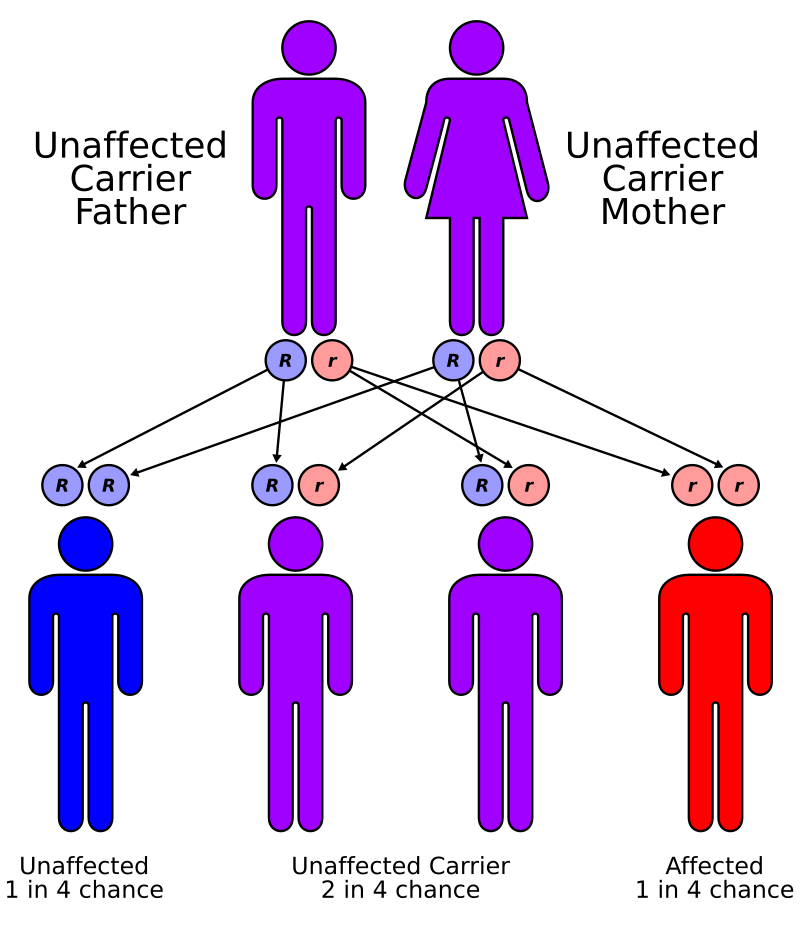
Figure 2-Punnett Square
AT is a disease that is inherited as an autosomal recessive trait. This means that it is expressed only when an individual receives the same abnormal gene from both the mother and the father. However, only one genetically mutated gene is necessary in order to become a carrier of the disease (someone would has genetic differences but do not show symptoms). As couples who have only one carrier between them cannot produce children in which the disease will be expressed (and therefore are not documented) and those who have already have the disorder only live to their early twenties in most cases (not likely to have children) the most common cases in which children contract AT during infancy is between two heterozygous parents. The risk for two carrier parents passing on their defective gene and
Figure 1-Visual Representation
have a child in which the disease is expressed is 25% (RR as illustrated in figure 2) and the likelihood that they receive normal genes from both parents and consequently be unaffected is equivalent (rr as illustrated in figure 2). Conversely, the likelihood in having a child who is also a carrier (heterozygous) is 50% (Rr as illustrated in figure 2). AT is a disease that usually begins during infancy (1-3 years of age) and is a disease that often is not isolated to one child (often affects more than one child in a family). AT affects both sexes equally on average and as previously stated is extremely rare occurring only once every 40,000 to 100,000 births globally (0.001-0.0025%).
Physical Traits and Symptoms
As AT is a disease that affects so many different systems within the human body, the symptoms are astronomical, however, the main affects that can be observed include:
Ataxia (difficulty with control of movement) that is apparent early but worsens in school to pre-teen years
Oculomotor apraxia (difficulty with coordination of head and eye movement when shifting gaze from one place to the next)
Involuntary movements
Telangiectasia (dilated blood vessels) over the white (sclera) of the eyes, making them appear bloodshot. These are not apparent in infancy and may first appear at age 5–8 years. Telangiectasia may also appear on sun-exposed areas of skin.
Problems with infections, especially of the ears, sinuses and lungs
Increased incidence of cancer (primarily, but not exclusively, lymphomas and leukemias)
Delayed onset or incomplete pubertal development, and very early menopause
Slowed rate of growth (weight and/or height)
Drooling particularly in young children when they are tired or concentrating on activities
Dysarthria (slurred, slow, or distorted speech sounds)
Diabetes in adolescence or later
Premature changes in hair and skin (graying of hair for instance)
Hypersensitivity to ionizing radiation with increased susceptibility to cancer (usually leukemia or lymphoma)
Endocrine abnormalities including insulin-resistant diabetes mellitus and premature ovarian failure (i.e., normal menarche followed by irregular menses and loss of ovarian function before age 40 years)